

Foundation Shade Match for Olive Skin: 7 Simple Steps
Table of Contents
- Why Olive Skin Is So Hard to Shade Match
- How to Find Your Skin Undertone: The 3-Test Olive Check
- Olive vs. Warm, Cool, and Neutral: What the Labels Actually Mean
- Using a Foundation Shade Finder (and Reading Shade Ranges)
- Foundation Swatches for Olive Skin: A Step-by-Step Face and Jawline Test
- How to Choose Foundation Online Without Guessing
- Fixing a Near-Match: Orange Cast, Pink Cast, and Mixing Shades
- Conclusion
- Frequently Asked Questions
Last Updated: October 16, 2026
Why Olive Skin Is So Hard to Shade Match
Olive skin has a green or gray cast between warm and cool, and most foundation lines ignore it. This guide from Rose Noir Cosmetics walks through a foundation shade match for olive skin in seven steps, from reading your undertone to fixing a bottle you already bought.

Here is the catch most guides skip: olive is not a depth. Fair through deep skin can all be olive, so a brand can carry forty shades and still have almost nothing for you.
The result is a familiar cycle: a "warm" shade turns orange, a "cool" shade turns pink or ashy, and "neutral" looks gray.
That cycle is fixable, and it starts with three quick tests you can run at home today.
How to Find Your Skin Undertone: The 3-Test Olive Check
Finding your undertone decides everything else. Run these three tests and look for a pattern, not one answer.
Test 1: The vein check. Look at the veins on your inner wrist in daylight. Blue and purple leans cool. Green leans warm.
Test 2: The jewelry check. Hold silver against your jaw, then gold. If silver looks cleaner and gold looks harsh, you lean cool-olive. If gold flatters and silver looks dull, you lean warm-olive.
Test 3: The white paper check. Hold a plain white sheet next to your bare face in daylight. If your skin looks greenish or slightly gray against the white, that is your olive signal.
Most people get one ambiguous test. Two out of three pointing the same way is your answer.
The Smithsonian's skin tone research on melanin and color explains why skin color varies so widely, which helps you understand why a single label rarely fits.
Olive vs. Warm, Cool, and Neutral: What the Labels Actually Mean
Undertone labels describe your skin's underlying color, not its depth. Warm leans golden, cool leans pink or blue, neutral sits in the middle, and olive is the fourth category, carrying a green or gray base the others do not.
At the counter, a warm foundation's golden base meets your green and reads orange, while a cool foundation's pink over green reads muddy.
| Undertone | Base color | On olive skin it reads as |
|---|---|---|
| Warm | Golden, yellow | Orange cast |
| Cool | Pink, red, blue | Pink or ashy cast |
| Neutral | Balanced beige | Flat or gray |
| Olive | Green, gray | Correct, if depth matches |
Neutral shades are the closest starting point for many olive tones, but most still run slightly pink or yellow, that gap is why a shade can look almost right and still feel off.
Using a Foundation Shade Finder (and Reading Shade Ranges)
A foundation shade finder is a quiz that asks about your depth, undertone, and sometimes your current shade. It narrows the field fast but does not replace a real test on your skin.
Be honest in the quiz. Most ask how your skin reacts to sun, what jewelry you wear, and what your veins look like.
Why screens lie. Every screen renders color differently, and most ship with a warm or cool tint, so a shade that looks neutral on screen can look pink on your face. Two habits reduce the risk:
- Turn off any night-shift or blue-light filter before you compare swatches.
- Set your screen to a neutral or standard color profile if your device offers one.
- Compare the brand's swatch against a known reference, like a white sheet or a gray card, rather than against the product photo alone.
Read the shade range itself. A few things to check:
- Does the brand separate undertone from depth? Good ranges list both.
- How many olive or neutral shades exist per depth? If there is one olive shade for the entire medium range, expect a rough match.
- Do the swatch photos show real skin? Studio swatches on a white background hide the cast that matters.
- Is there a shade guide with descriptions? Words like "golden," "beige," and "cool" tell you more than a name alone.
Plan for samples before you commit. Many brands sell sample cards, minis, or travel sizes, and a sample costs far less than a full bottle you cannot use. If none is offered, order the smallest size available.
Plan the return before you buy. Read the return window and whether opened foundation is eligible.
If you are shopping online, the FTC guidance on online shopping and returns is worth a look before you buy. It covers your rights when a product does not match its description.
Match the formula to the test, not just the shade. Coverage and finish change how a color reads: a full-coverage matte can look deeper and warmer once set than the same shade in a sheer, dewy formula. When testing online, stay within one finish family so color is the only variable.
Foundation Swatches for Olive Skin: A Step-by-Step Face and Jawline Test
Swatching is where a foundation shade match for olive skin is won or lost.
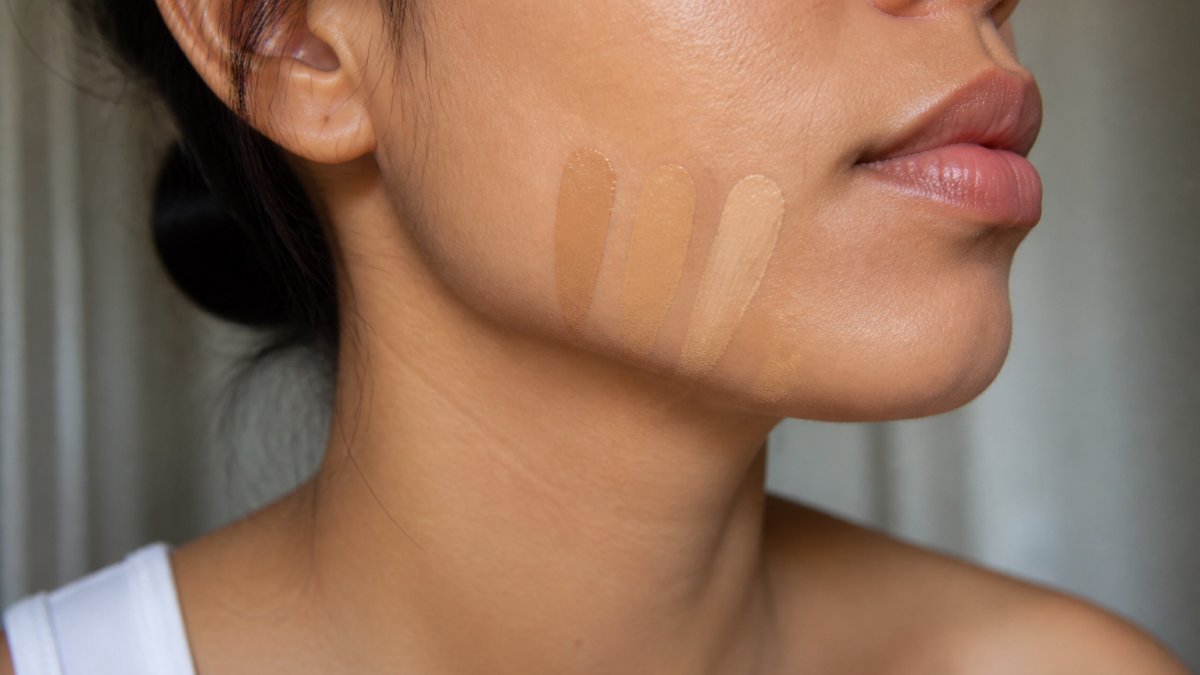
Step 1: Pick three shades. One you think is your depth, one a half-step lighter, one a half-step deeper. Bring two undertone options if you can.
Step 2: Stripe them along the jawline. Draw thin lines from cheek to jaw, not on the back of your hand.
Step 3: Blend one stripe toward your neck. This is the stripe that tells the truth.
Step 4: Step into natural light. Walk to a window or outside. Look at the stripes with no makeup mirror filter.
Full Cover Foundation - Tones →
Step 5: Wait fifteen minutes. Foundation oxidizes, meaning it darkens and warms as it sets.
Step 6: Check the wear test. Leave it on for a few hours.
Step 7: Judge the blend line. The right shade has no visible edge at the jaw. If you can see where the foundation stops, keep looking.
How to Choose Foundation Online Without Guessing
Choosing foundation online comes down to three things: a good shade finder, a generous return policy, and a plan for a shade that is close but not exact.
Start with the shade finder quiz, then cross-check the result against the brand's shade guide.
Order two shades, not one. A half-step lighter and deeper give you room to mix, and mixing is normal for olive skin, many olive-toned people never find a single perfect bottle.
Check the return window before you buy. A brand that accepts opened foundation returns is worth more, so read the policy and keep your confirmation.
Our Full Cover Foundation comes in three undertone families, warm, neutral, and cool, with named shades across the depth range.
If you are unsure where to start, our team can help you narrow the range before you order.
Fixing a Near-Match: Orange Cast, Pink Cast, and Mixing Shades
A near-match is not a failure, it is a shade one variable off, and most can be corrected. Name the variable before buying another bottle.
If the shade turns orange: it is too warm or too deep. Try a half-step lighter, or a shade with a cooler or more neutral base.
If the shade turns pink or ashy: it is too cool. Move toward a neutral or a warm-olive shade.
If the shade looks gray: it is too neutral and flat for your skin. Add warmth with a deeper golden shade, or mix.
If the shade is the right color but the wrong depth: mix it.
Why oxidation matters more on olive skin. Foundation darkens and warms over the first ten to twenty minutes as it sets.
How formula and finish change perceived color. The same shade number can read differently across formulas:
- Coverage. Full coverage lays down more pigment, so the color reads truer and deeper. Sheer coverage lets your natural tone show through, which can make a shade look lighter and cooler than it is.
- Finish. A matte finish can look deeper and warmer once it sets. A dewy finish reflects light and can look lighter and cooler. If you are between two shades, a matte formula usually pushes you toward the lighter option.
- Wear time. Long-wearing formulas often oxidize more, because they are built to set and stay. If you know a formula oxidizes on you, start a half-step lighter.
A few mixing rules that save product:
- Mix on the back of your hand or a small palette, not directly on your face.
- Keep the ratio consistent, so you can repeat it.
- Mix only within the same formula. Mixing a matte and a dewy foundation changes how the blend wears.
- Store the mix in a small jar only if you plan to use it within a few days.
When mixing is the wrong fix. If a shade is two or more steps off in depth, mixing wastes product and rarely lands.
For a full-coverage olive match, our Full Cover Foundation in Sand is a solid neutral starting point for medium skin, with Bali and Dune nearby for a half-step up or down.

Conclusion
Getting a foundation shade match for olive skin right takes more work up front, but it stops the cycle of buying the wrong bottle. Run the three undertone tests, swatch on your jawline in daylight, and give the shade fifteen minutes to settle before judging it.
At Rose Noir Cosmetics, we stock a full range of undertone families so you can find a base that actually matches your skin, not the closest compromise. Our Full Cover Foundation offers blendable full coverage, a matte finish, and a paraben-free formula that suits all skin types, in a 30 mL bottle at $34.60.
Start with our shade range, pick a neutral shade close to your depth, and adjust from there. Get started with Rose Noir Cosmetics and find a foundation that finally disappears into your skin.

Frequently Asked Questions
What foundation works best for olive undertones?
Look for shades labeled neutral, golden, or warm-neutral rather than pink or cool. Olive skin has a greenish-gold cast, so a foundation with a yellow or golden base blends in without turning gray. If a shade looks slightly too yellow on its own, it may still be the right depth once it settles. Choose a formula that matches your finish preference, like a matte full-coverage option, and test it on your jawline before committing.
How can I tell whether my skin has an olive undertone?
Run three checks: look at the veins on your inner wrist (green-leaning veins suggest warm or olive), hold a white sheet of paper next to your bare face (olive skin can look slightly green or gray against it), and compare your face to your neck and chest. If your face looks pinker or more orange than your neck, you likely have an olive undertone. Do this in natural daylight, not bathroom lighting.
How do I choose a foundation shade for olive skin online?
Start with a shade finder quiz, then narrow to two or three candidates in your depth range. Read the undertone family for each shade instead of trusting the model photo. Order from a retailer with a clear return policy, and plan to swatch along your jawline and neck in daylight when the order arrives. If neither shade is perfect, buy one slightly lighter and one slightly deeper and mix them.
Why does foundation look too pink, orange, or yellow on olive skin?
Most foundations are built on pink (cool), peach (warm), or straight yellow bases. On olive skin, a pink base turns ashy or gray, a peach base reads orange, and a strong yellow base can look like a mask. The fix is to find a shade with a muted, green-leaning or golden-neutral base, or to mix a warm and a cool shade until the mix reads neutral on your jawline.