

How to Build a Daily Skincare Routine That Works
Table of Contents
- What You'll Need Before You Start
- Start With Your Skin Type and Concerns
- Skincare Routine Order: The Sequence That Matters
- Morning Skincare Routine Steps
- Night Skincare Routine Steps
- Skincare Routine for Beginners: Start Simple
- How to Introduce Active Ingredients Safely
- Troubleshooting Irritation and Breakouts
- Frequently Asked Questions
Last Updated: October 12, 2026
What You'll Need Before You Start
Building a daily skincare routine starts with less than you think. You need four things: a gentle cleanser, a moisturizer, a sunscreen with SPF 30 or higher, and patience. That's it. Everything else is optional.
This guide from Rose Noir Cosmetics walks you through how to build a daily skincare routine that actually fits your life. No ten-step systems. No products you'll abandon in a week.
Here's what most guides get wrong: they hand you a 12-product list before you know your own skin. That's backwards. A routine you'll stick with beats a perfect one you quit.
Below, we'll show you exactly how to pick products, layer them in the right order, and add stronger ingredients without wrecking your skin barrier. The result is healthy-looking skin you can maintain for years.
Start With Your Skin Type and Concerns
Your skin type decides which products belong in your routine. Get this wrong and even good products will fight you. This section gives you a decision tree, not a label.
Step 1: Identify your skin type. Wash with a plain cleanser, wait one hour without applying anything, then look in a mirror and press a blotting sheet to your forehead and cheeks.
- Dry skin: Feels tight, flaky, or rough after washing; blotting sheet shows little to no oil.
- Oily skin: Shiny within an hour, prone to clogged pores; blotting sheet shows oil across the T-zone and cheeks.
- Combination skin: Oily in the T-zone, dry or normal on the cheeks; blotting sheet shows oil mainly on the forehead and nose.
- Sensitive skin: Stings, reddens, or reacts easily to new products, even ones labeled gentle.
Step 2: Pick one primary concern and one secondary concern. Dark spots, fine lines, acne, redness, or texture. Trying to fix five things at once is how routines fall apart. Two is the ceiling for a beginner routine.
Step 3: Match products to your type and concern using this decision logic.
| Skin type | Cleanser | Moisturizer | Sunscreen | First active to consider |
|---|---|---|---|---|
| Dry | Cream or milk cleanser | Ceramide or glycerin cream | Hydrating cream SPF | Low-strength retinoid for fine lines |
| Oily | Gel or foaming cleanser | Lightweight gel or lotion | Gel or fluid SPF | Niacinamide or salicylic acid |
| Combination | Gentle gel cleanser | Lotion, heavier on cheeks | Fluid SPF | Niacinamide |
| Sensitive | Fragrance-free cream cleanser | Fragrance-free barrier cream | Mineral or fragrance-free SPF | None until three-product base is stable |
Step 4: Set a budget before you shop. The three essentials, cleanser, moisturizer, sunscreen, are where drugstore formulas perform close to prestige ones.
Skincare Routine Order: The Sequence That Matters
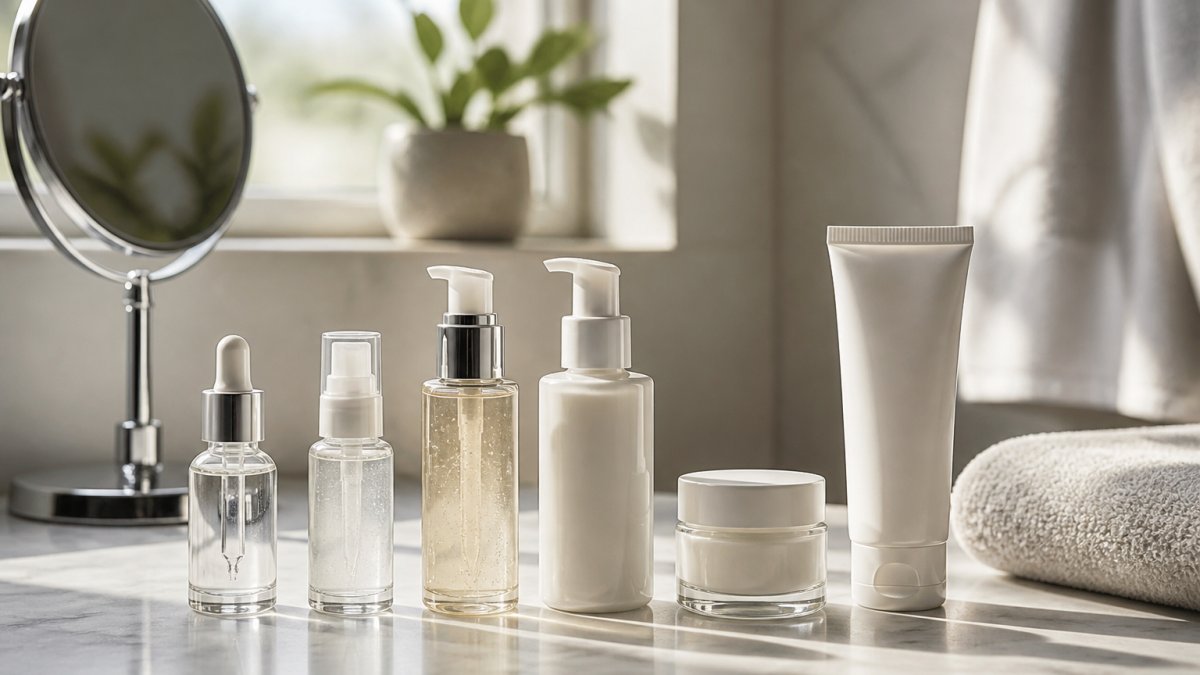
Apply products from thinnest to thickest. That single rule solves most layering questions. Water-based formulas go first, heavier creams go last, and sunscreen always finishes the morning routine.
Here's the order:
- Cleanser
- Toner or essence (optional)
- Serum or treatment
- Moisturizer
- Sunscreen (morning only)
Why does order matter? Thin products can't soak through a thick cream barrier. Put the cream on first and your serum sits on top, doing nothing.
Wait about 30 seconds between steps. You don't need to let each layer fully dry, just give it a moment to settle.
Morning Skincare Routine Steps
A morning routine should take under three minutes. It's about protection and prevention, not repair.
Step 1: Cleanse. Rinse with lukewarm water or use a gentle cleanser. If your skin feels tight afterward, your cleanser is too harsh.
Step 2: Moisturize. Apply while skin is still slightly damp. This locks in water and keeps your skin barrier strong.
Step 3: Sunscreen. Use a broad-spectrum SPF 30 or higher. This is the single most effective step for preventing dark spots and early aging.
Most people under-apply sunscreen. Use about two finger-lengths for your face and neck.
The American Academy of Dermatology sunscreen guidelines recommend broad-spectrum protection with SPF 30 or higher for daily use, reapplied every two hours outdoors.
Night Skincare Routine Steps
Nighttime is when your skin repairs itself. Your evening routine can be slightly heavier and more targeted than your morning one.
Step 1: Cleanse. Remove sunscreen, makeup, and the day's buildup. If you wore heavy sunscreen, a double cleanse helps: an oil-based cleanser first, then a gentle water-based one.
Step 2: Treat. Apply your serum or active ingredient to clean, dry skin.
Step 3: Moisturize. Seal everything in with a face cream suited to your skin type.
Step 4: Eye cream (optional). Pat a small amount around the eyes if dryness or puffiness bothers you.
That's the whole evening routine. Three or four steps, done consistently, outperforms a complicated system you skip half the time.
Skincare Routine for Beginners: Start Simple
A beginner routine has three products and two daily steps. Skip the toner, essence, facial mist, and mask for now. Add them later if you want to.
The 12-week starter schedule
Weeks 1-2: Cleanser, moisturizer, sunscreen. Nothing else. Apply morning and evening; sunscreen morning only.
Weeks 3-4: Keep the same three. Notice how your skin behaves. Take a photo in the same lighting once a week so you have an objective record.
Weeks 5-8: Add one active for your primary concern. Use it at the lowest available strength, twice a week, on dry skin.
Weeks 9-12: Hold. Do not add a second active yet.
Week 13 onward: Add a second active only if the first is fully tolerated and you still have an unaddressed concern. Two weeks between additions, always.
How long until you see results?
- Hydration and plumpness: within days.
- Redness and irritation from a too-harsh product: improves within one to two weeks of stopping it.
- Acne and clogged pores: four to eight weeks of consistent use.
- Dark spots and post-acne marks: eight to twelve weeks, often longer.
- Fine lines: twelve weeks or more, and results are gradual.
Expecting faster results leads to overuse, and overuse leads to irritation. If you are three weeks in and see nothing, that is normal, not a reason to add three more products.
When to pause, simplify, or see a professional
- Pause all actives for one week if you have stinging, burning, flaking, or raw patches. Keep cleanser, moisturizer, and sunscreen only.
- Simplify if you cannot name what each product in your routine is doing. Cut back to the base three and rebuild.
- See a dermatologist if acne is painful, cystic, or scarring; if a rash spreads or blisters; if you have a mole changing in size, shape, or color; or if a concern has not improved after twelve weeks of a consistent, correctly used routine. Persistent conditions often need prescription treatment, not another over-the-counter serum.
U.S. Food and Drug Administration guidance on cosmetic product safety notes that cosmetics and their ingredients are regulated for safety, but individual reactions still vary. Patch-test new products on your inner arm before using them on your face.
How to Introduce Active Ingredients Safely
Active ingredients like retinoids, vitamin C, and exfoliating acids deliver real results. They also cause most of the irritation people blame on "bad skin."
Follow these rules:
- Add one active at a time. Never start two in the same month.
- Start low, go slow. Use a low strength twice a week, then build up.
- Apply to dry skin. Wet skin absorbs actives faster and stings more.
- Buffer if needed. Moisturize before and after to reduce irritation.
- Skip on damaged days. If your skin is raw or peeling, pause the active.
| Active | Start With | Frequency | Best Time |
|---|---|---|---|
| Retinoid | Low strength | 2 nights per week | Evening |
| Vitamin C | 10% or less | 3 mornings per week | Morning |
| AHA/BHA exfoliant | Gentle formula | Once weekly | Evening |
| Niacinamide | 5% or less | Daily | Either |
How long do products take to work? Hydration improves within days. Dark spots, fine lines, and acne take longer. Most people see real change after eight to twelve weeks of consistent use. Expecting faster results leads to overuse, and overuse leads to irritation.
Troubleshooting Irritation and Breakouts
Irritation and breakouts have different causes, so they need different fixes. Figure out which one you're dealing with before changing anything.
Irritation looks like redness, stinging, flaking, or burning. It usually appears within hours or days of a new product.
Purging looks like small bumps in your usual breakout areas. It shows up after starting an exfoliant or retinoid and settles within a few weeks.
A true breakout appears in new areas, often with itching. That points to a product your skin doesn't tolerate.
What to do:
- Stop all actives for one week. Keep cleanser, moisturizer, and sunscreen only.
- Reintroduce products one at a time, two weeks apart.
- If irritation returns with the same product, drop it for good.
- For stubborn acne, see a dermatologist rather than stacking more products.
A simple routine, followed twice daily, beats a complex one you can't maintain. Skin appearance improves through consistency, not product count.
Frequently Asked Questions
What order should I apply skincare products?
Apply products from thinnest to thickest: cleanser, toner or essence, serum, treatment, moisturizer, then sunscreen in the morning. Wait about 30 to 60 seconds between steps so each layer absorbs. This order lets water-based formulas sink in before heavier creams seal them. If you use an active treatment like retinol at night, apply it after serum and before moisturizer to buffer irritation. A consistent daily skincare routine depends on this sequence more than on how many products you own.
What should a basic morning skincare routine include?
A basic morning skincare routine needs three steps: a gentle cleanser or a water rinse, a moisturizer suited to your skin type, and a broad-spectrum sunscreen with SPF 30 or higher. If you have a specific concern like dullness or uneven tone, add one serum before moisturizer. Keep the morning light so you actually stick with it. Sunscreen is the step that protects everything else you do, so apply it last and reapply through the day when you are outdoors.
How long do skincare products take to work?
Hydration and barrier support can show up within a few days, while texture, tone, and breakout changes usually take four to twelve weeks of consistent use. Active ingredients like retinoids and exfoliating acids need gradual introduction, often starting once or twice weekly. Give any new product at least a month before judging it, and photograph your skin weekly so you can see slow progress. If irritation appears, stop the new product and return to a simple routine before reintroducing it.
Can I use two serums together in my skincare routine order?
Yes, but not all pairings work. Use one water-based serum first, then a treatment serum, and avoid layering strong exfoliating acids with retinoids in the same session because the combination can overwhelm your skin barrier. If you want both, alternate nights instead. When adding a second serum, introduce it alone for one to two weeks so you can tell which product causes any reaction. This approach keeps your daily skincare routine effective without triggering redness or peeling.
Finding products that fit your skin type, your budget, and your routine shouldn't take hours of guessing. At Rose Noir Cosmetics, we stock everyday cleansers, moisturizers, sunscreens, and treatments for all skin types, with straightforward product pages that tell you what each formula is for. Our online store makes restocking simple, so your routine never stalls because you ran out of sunscreen. Get started with Rose Noir Cosmetics and build a daily skincare routine you'll actually keep.